Wednesday, August 26, 2020

Warhammer Underworlds Battle Report: Wild Hunt vs. Profiteers

 Alright, so I'm super behind on this but me and Jeremy were able to get together a few weeks back and play a couple of games. One of the games we got in was Warhammer Underworlds, so I thought I'd be nice and bring you a little battle report.

Full disclosure: I totally forgot to screencap our decklists, so I don't have that info readily available. Sorry, rookie mistake.

So our warbands were Skaeth's Wild Hunt played by yours truly, and Jeremy brought Thundrik's Profiteers. 

The Wild Hunt

The start of turn one

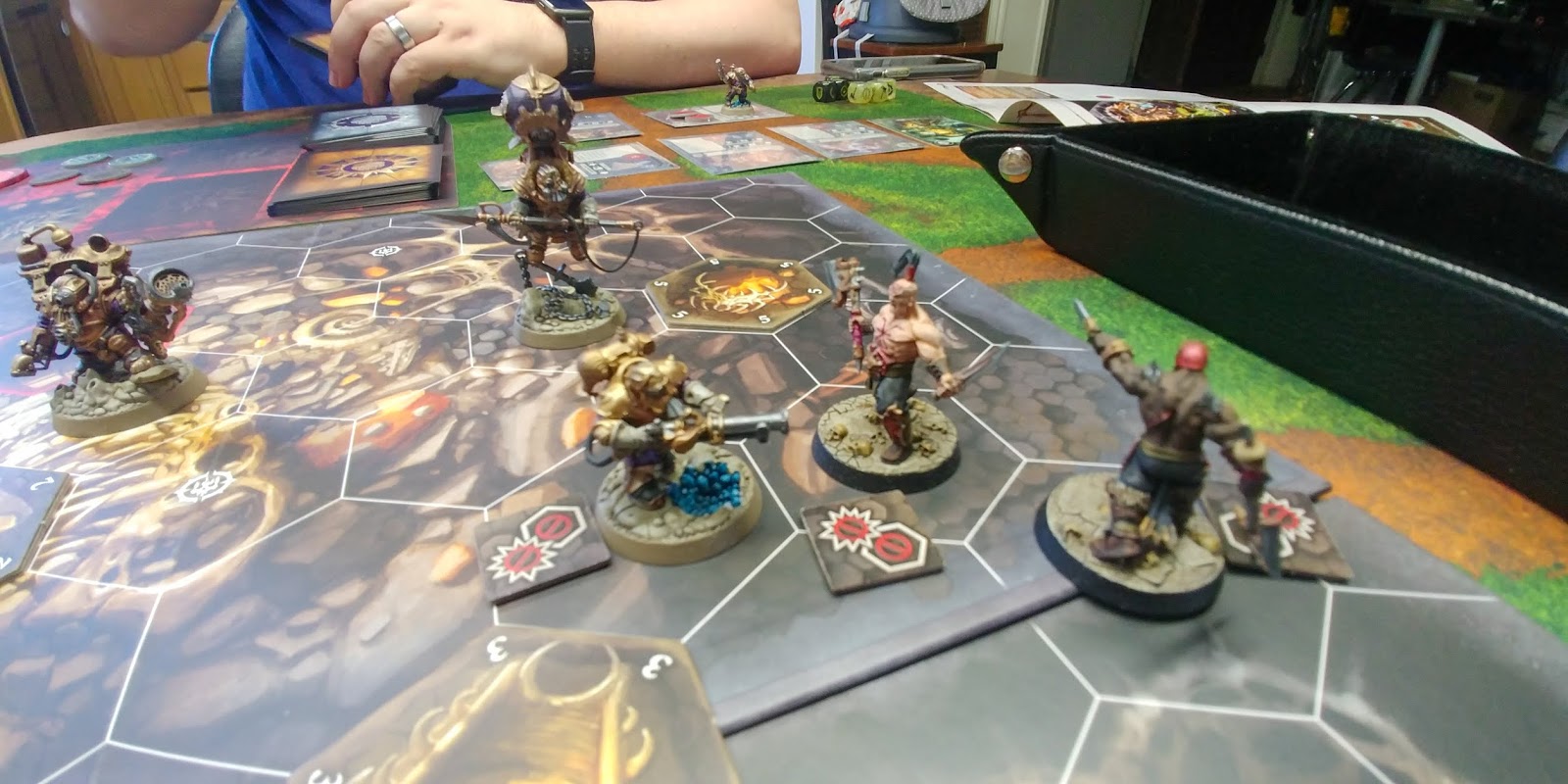
You can see the set up from the above picture. I tried to keep my guys near objectives in case I drew cards to let me score them (although the website we used for deck building didn't have either of us put in the simple "score objective X" cards), but also trying to play to my speed. Knowing how many ranged attacks Jeremy had made me a little cautious, but I was determined to get Althean up there to start shooting.

There was lots of positioning in turn one, mostly with Jeremy trying to keep up with whatever I was doing. I needed to hold three objectives to score one of my objective cards, so I had to be very aggressive from the word go to try and score it.

Karthean makes a bold move to smack some Dwarfs

I also had aKurnoth's Snare that I could score if I could push an enemy model into a lethal hex, so I rushed Karthean up into the fray pretty fast to try and score that. Sadly my dice rolls were having none of it, despite my best attempts to stack them in my favor.

At the end of turn one I managed to score a couple of glory points, while Jeremy I think got one. So we weren't off to a super fast start, but now I had models up in the thick of it with some Dwarfs looking for blood. Althean ended up getting blasted before the turn was done, which was not something I was excited about since she was the only model I had that could compete with the range of the Dwarfs. 

The end of the first turn

Skaeth got himself some upgrades.

Turn two saw a lot of me trying to get a push to score that one objective card, while also trying to figure out what I was going to do with the others in my hand. I kept Karthean and Lighaen on the offensive, trying to keep Jeremy from being able to swing around and advance to my side.

For the most part things went well, although through a serious of worthless dice rolls neither of us really accomplished too much. We did, however, decide to be smart-asses and both played Mischevious Spirits and moved the objective hexes around a bunch because why not?


This is what two Mischievous Spirits gets you, I guess.

Turn three saw more action as Skaeth finally got in on the action, but only after both Karthean and Mr. Whiskers took a bit more abuse and tried their damnedest to push Enrik into that lethal hex and failing miserably. Skaeth charged up, chucked his javelin and managed to do the job right by not only pushing Enrik into the hex but also killing him in the process. In doing so I managed to score two of my objective cards, including finally scoring Kurnoth's Snare! It's a bloody miracle!


Skaeth steps up to show the boys how its done

Going into the last turn Jeremy needs to pull off a combo to take the lead from me, and he tries so hard but only partially succeeds. Thundrik uses his ability to create a bunch of lethal hexes which ends up sort of locking down Karthean and Mr. Bigglesworth, and my dice rolls were simply not in any way doing me the good to deal damage to him. Skaeth couldn't reach him, so I opted to charge Dead-Eye Lund with Sheoch in a hope to hit hi hard. I realized I should have charged him up sooner to inspire him early, getting that vital extra die, but alas nothing comes of it. Thankfully Dead-Eye ends up failing to live up to his namesake and manages to fail to blow Sheoch away.


thundrikistiredofyournonsense.png

Jeremy makes a couple of last moves, moving Thundrik onto a lethal hex to try and score one of his objectives. Ultimately turn four ends with no further bloodshed, and the game ends with a 5-4 win for the Wild Hunt. 

Endgame

Overall it was a fun game, even with the frustration of my dice rolling being just awful. Seriously, I know dice can be finnicky, but the absurd number of supports I rolled instead of hits when I needed them was killing me a little. It was still fairly close, and had Jeremy been able to pull of the combo he was going for he would have taken the game. Going into turn four neither of us had great objective cards to work with, so I mostly had to try and keep Jeremy from doing what he hoped to do. 

I hope you've enjoyed this little battle report. I plan to do more in the future, and I'll make sure I have our decks available for all to see (and try to be more on top of actually posting).


Wednesday, July 15, 2020

Throwdown: Warhammer Underworlds vs. Godtear


It's the moment I'm sure someone has been waiting for, and something I'm surprised I'm having trouble finding other bloggers discussing: the battle between Warhammer Underworlds and Godtear. This isn't a definitive answer to "which is better" or anything, just my thoughts on the two games and since they're aiming ti fill a similar spot in the market it seemed like as good a time as any to toss them into the ring together.

DING DING

Price
So let's start off with the big one: price to play. In this regard the two games aren't too terribly far apart. Underworlds does have a higher starting cost, with the starter set for the current season Beastgrave retailing for $75. Conversely, the both of the Godtear starters retail at $50. So right off the bat Godtear is cheaper to get into if you're buying the starter.

Expansion wise the two are pretty comparable. Most Underworlds warbands retail around the $33 mark, and new champions for Godtear retail at $30. With Godtear you'll get between four and six models per pack (with a couple of exceptions like Shayle or Keera), and in Underworlds you're looking between three and six models. However, in Underworlds you also get a stack of objective and power cards, which do factor into the overall cost.

Content of Starters
I want to touch on this because I feel like this is important, but I'll try to not drag on too long (no promises). Both starters get you a good amount of content, and obviously get you enough to start playing right out the gate. I'd say that in terms of amount of stuff the two games are fairly comparable, but Underworlds does have a little bit more (which is part of the cost). Not only do you get two warbands (totaling 11 models), you get all their stat cards, player cards, tokens, dice, two double-sided boards and rules. So it's a pretty packed box (the older starters are lighter on the models front as they both come with three man Stormcast warbands).

With Godtear, regardless of which starter you pick, you get ten models, six cards, a double-sided board, tokens, player dashboards, rules and dice.

The boards for Underworlds are, individually, smaller, but put together (as they would be for a game) they're probably around the same amount of material as the Godtear one. I will say this, though: the Underworlds boards have way better defined hexes on them. The desert side of the Godtear board is fine, but the woodland side seems to be really faded and can make finding hexes a bit of a pain in the ass.

Underworlds is also more versatile for demoing since the warbands are self-contained, while with Godtear a standard game is three champions per side.

The Models
So this is the big one, the one everyone is going to look at first. So, I'm going to say up front that I'm only judging them by the quality of the build. Everyone is going to have differing aesthetic tastes, so there's little point in my factoring that in here.

And without a doubt the winner here is Underworlds. I may have my gripes with GW, especially their rules teams, but I can never fault the sheer quality of their plastic models. The material is sturdy and solid, and I have almost never seen miscasts on GW plastics. The Godtear models aren't bad, per se, but they are of a more board game quality so some warping is possible (thankfully the individual champion packs come with a clear plastic front so you can actually see the models you're buying to inspect for any major warping).

Pick up and Playability
Here I'd say Godtear takes it. The ability to just open a new champion and play right away with them is super nice. While the Underworlds models are of better quality they do require assembly first, and while they are push-fit models if you don't have hobby clippers handy at that exact moment then you're sort of S.O.L.

The Rules
I've gone over these in more depth in my two reviews, so this is just a formality more than anything. I find both the rules to be quite good, smooth and easy to get. Both offer plenty of tactical depth and encourage players to really think through their moves and be smart. I think Underworlds has a great system with the limited number of activations, and Godtear's plot/clash phases adds a nice layer of depth. Both have their ups and downs, but Underworlds certainly seems to have less player downtime which I appreciate.

I will say that I think Godtear has the leg up on it's versatility; it's a lot easier to change things up between games since you just swap models than having to change up a deck and swap a bunch of cards.

Accessibility
So how easy is it to actually get your hands on these games? As it turns out, pretty damn easy. Both are, generally, speaking available from most online retailers, and I've seen them both in several local shops as well. It does seem, however, that GW is really bad at keeping stuff in stock on their own store. Of the like two dozen warbands available for Underworlds, only half of those are available on GW's shop (I suppose, technically, 14 if you count the two in the starter). However, if you go through anyone but GW's official store you should have your pick of the litter.

Overall
Both games are great fun, and really I can't say one over the other is better. It really comes down to what you want in it: if you want something more akin to the general miniatures gaming hobby then Underworlds is a good choice, if you want something with less prep work to play then Godtear is probably the better choice. They are both solid games, and I highly suggest checking both out if you get a chance.

For me? I'll probably stick to Godtear for a bit. I like the ability to just swap models around easily to change up your play style, and I like the fact I can just buy whatever I think looks cool. If I can find people to play Underworlds with (lord knows I don't want to play with the people I saw playing at one of my LGS' a while back, the dead-eyed "you can't have fun unless you win" types) then I'd absolutely jump in. As it currently stands, Godtear will be my game of choice when it comes to this type of thing.

Get some demos, both are totally worth it and have some fun.

I hope this has been somewhat informative for you, and I hope this gives you some ideas for new games to check out.

Sunday, July 12, 2020

Review: Warhammer Underworlds


Another post, another review.

The other game me and Jeremy played in our breaking of quarantine was Warhammer Underworlds, a game I've been watching but hesitant because it's made by none other than Games Workshop.

Now anyone who knows me, or knows someone who has ever spoken to me about tabletop gaming, knows I'm not the biggest GW fan in the world, and that I pretty routinely point to Warhammer 40K as an example of "how not to make a game." But, even I am willing to give them a chance and don't think they're an entirely lost cause.

So once again Jeremy has a ton of stuff, and all the models were painted by him.

Just a quick note, I won't be making direct comparisons to Godtear here, despite them being fairly direct competition. There will be an upcoming post with comparisons between the two.


Garrak's Reavers, one of the first warbands in the game.


To start each player needs to choose a warband of predetermined models, of which there are currently 24 available covering a variety of factions from the Age of Sigmar setting. Not every faction is represented yet, but a decent number of choices exist. I'm not super keen on the warbands being predetermined because it means we saw a lot of Sigmarines, er Stormcast, real early and there are four of those in the game currently.

Each fighter has a stat card which has two sides, the normal side and the fighter's inspired side. Different warbands have different requirements to inspire fighters, and once they are they usually hit harder and gain extra abilities in combat. Below you can see both sides of the card of Garrek (and yes someone got paid legal tender to come up with the name "Gorebeard" and I'm utterly disgusted).


Instead of switching models around to change up ones play style and strategy in a game, players instead change up their decks of cards. Each player has two decks they work with during a game: an objective deck (how one scores glory points) and a power deck which contains cards you can play to give fighters a temporary boost or upgrade them permanently. And this is something that I'm not entirely sold on. It's a neat idea, and it does add some variety to the game, but I'd really rather just swap out models to change my strategy. n top of that it becomes a case of "buy this box of models you might not want to get a couple of cards that are really good" and that's never a good thing to me. Maybe it's not as bad as I think it is from an outsider perspective, but a lot of the more useful generic cards only come in the starter sets, so if those don't have warbands you care about then they aren't really a good investment. It also means that swapping things around requires a fair bit of faffing about, and god help you if you share cards between decks for multiple warbands.

Okay, on to actual gameplay. I will say right up front, I found the gameplay to be quite good. I went in expecting the usual GW fare: IGOUGO and clunky ass phase system. I was pleasantly surprised to find that it does neither of those things, so good on ya GW for having game design from the 21st century!

Each turn both players get four activation tokens, and when they choose to do something with a model they have to spend one of those tokens. So, moving a model will cost an activation, attacking another, you can do charges to move and attack with a single activation at the cost of not being able to do anything else with that fighter during that turn. This is a really nice mechanic because it forces players to think their turns through. If you have a warband with six models not all of them will go each turn, so you need to make sure you use those activations wisely. If you have a warband with only three models you also need to plan out how to use those activations because you can have a model activate twice, but things like moving can only be done once in a turn. It adds a surprising layer to tactical depth that I wasn't expecting.


A player board showing decks, activation tokens and glory points.


Combat is fairly smooth and easily handled, and I am so glad it isn't a clunky mess of comparing stats on a table. Fighters have attacks listed on their cards showing the range in hexes, how many attack dice they roll, what symbol they need on the dice to succeed and how much damage the attack does. It's all fairly self contained and easy to follow.

Each model also has a defense stat, showing how many defense dice they roll (for there are three different dice when you factor in magic dice, but we didn't have any experience with that between the warbands we ran) and what symbol they need.

Combat is quick, which makes the game go by without feeling like it's dragging. There's nothing terribly complex, although the support rules seem a little muddled or poorly worded. They remind me of the blocking rules from Blood Bowl, which are the one part of the rules of that game which I really don't like because it always seems to muddle things. It's entirely possible these ones aren't as bad, but we did have to spend a few minutes trying to figure out how much support fighters got when there was a bit of a cluster of a combat.


Some fighters in the thick of the fight, throwing dice and spilling blood.

Another thing I could say about the game that might be a criticism is that it does seem like there is a good number of tokens to keep track of, and if you have a lot of guys moving and charging things can little a bit cluttered. This doesn't really impact gameplay at all, and I suppose one could just put charge and move tokens on the stat cards if they don't want the board getting filled up.

Cost wise the game can be a bit hit and miss. A starter box retails at $75, which is a pretty chunk of change right up front. Especially if that box doesn't contain warbands you care about. You can buy dice separate, and GW even sold game boards separate but in classic GW pricing they were $35 for a single board (each game requires each player to have a board, so all the pictures here are showing two boards on the table). Each warband retails at around the $33 mark, which isn't terrible depending on the warband. For a three model Stormcast warband that's a bit of a punch in the dick, but for stuff like the Godsworn Hunt that has something like five or six models it's not so bad. They do also come with a fair number of cards to add to that cost, and unlike some folks online I understand that those do have to be factored into the cost somehow.


The Reavers make a hard push while Garrek holds an objective.


All in all, I will say I was quite surprised and pleased at much fun we had with Underworlds. The rules are smooth and easy to get (if not laid out super well in some places), the game plays fast, it doesn't have the GW "clunky, antiquated system from the 80's because grogs can't handle change" thing going on and the tactical depth stunned me. Yeah it's a bit pricey to start with, and if you don't like warbands in the starters then getting a good starting collection of cards will mean buying multiple warbands and there are some cards only in those starters which sucks a bit.

Overall, solid game worth checking out. If you've got someone in your playgroup that might be willing to split a starter with you, or just has one then that can really help. If someone at your LGS (when those are allowed to be a thing again) is doing a demo it's worth checking out. If you like the Age of Sigmar setting and style and want something fast and easy with nice models (detail wise and quality wise, if not always design wise) then this is worth looking into. 

Friday, July 10, 2020

Review: Marvel Crisis Protocol


So the other day my buddy Jeremy and I decided to be bad and break quarantine (not that one was ever established in this bloody state) to do some gaming. He had some games we wanted me to try, and among those was Marvel Crisis Protocol from Atomic Mass Games. So, we opted to throw down and give the beginner scenario a whirl.

One thing right off the bat I will say is that the model are quite nice, especially once painted up by someone with some actual talent. Jeremy's got every model currently available (he went in hard), but we just used the suggested models from the starter box.

If you want to check out more of Jeremy's work on Crisis Protocol and various other games, check out his Instagram page.


A selection of models from the starter set.

The game actually plays pretty quick, and uses some interesting mechanics. Each character has a stat card that details their attacks, defenses and super powers. The cards are double sided, with one side being their starting stats and the other side is flipped to after the model has received enough wounds to get dazed the first time. Everything's pretty well laid out, but the cards are pretty big which is a minor quibble.

Every turn characters generate power tokens they can use to do more powerful attacks or activate their super powers, and in an interesting twist models also gain power tokens anytime they get wounded which means as they get hurt they can end up doing more incredible things. It's all very appropriate to the genre, really.

Characters activate in an alternating activation system, so there's very little downtime which keeps players engaged.

An overview of the table, turn two.

One of the most engaging things about the game is that all the terrain is interactive, meaning models can pick up terrain pieces and chuck them around the table at each other. It's actually pretty neat, and as terrain is thrown around it gets destroyed which can open some strategic options for opening up fire lanes for more ranged characters like Hawkeye or Iron Man. It also helps with that comic-book feel, and it's just damn fun to have Doctor Octopus chuck a dumpster at Black Widow.


Iron Man lines up a shot against Baron Zemo.
                                       

All movement and range is done via templates that are included in the starter, or you guy buy them separate if you just want to grab some two-packs of characters. It feels like something made by Fantasy Flight, which seeing how both FFG and AMG are owned by the same company might mean there's some crossover. It does mean no need for a measuring tape, but it does also just add to the pile of stuff needed to play.

Speaking off piles of stuff, holy damn can this game get heavy on the tokens. Tokens to track wounds, track power, track status effects (of which there are many) and some that are character specific and so on. Cards can pretty quickly get crowded with tokens, which is a bit of a pain to be honest. Not deal breaking, mind, but obnoxious. It also means you, the player, need to find something to store all those tokens in, and if you don't buy the starter box then you don't get those tokens.

Seriously, all the tokens.

Combat is done by rolling the special dice that come with the game, but can also be purchased separate if you wish, with each attack or super power listing what type it is (physical, energy or mystical) and how many dice you roll along with the range of the attack. Attacks can hit, critical hits let you roll an extra dice (the one time, no continuously exploding dice) and the wild face lets you count it as a success and often will let you do an extra thing (Captain America's "Shield Throw" attack, for example, lets you make another attack against a target within range 2 of the first target if you get a wild). The dice are used for both attack and defense, so they also have a defense face but a model can still benefit from crits and wilds. It's all pretty smooth, and the wilds adding that extra little perk is a nice touch.

Something that took me by surprise is that the game lets you just make a team with whoever you want. There are benefits to running specific teams, usually in the form of a model having a super power that benefits from having other models from that team around, but otherwise your free to mix and match as you see fit. A standard game is, I believe, 17 points, and no player can ever have more than ten models in their list. Keeps things nice and small, which is nice, and gives people lots of freedom compared to something like the Batman Miniatures Game which has very specific team options.


Despite what it looks like, Iron Man and Spider Man are not on the same team here.

 The only other thing I can really think of as a fault for the game is the price. The starter set, which does come with a ton of stuff, retails at a hundred bucks. Sure you get terrain, templates, rulebook (although the full rulebook is available online as a living rulebook), dice and ten models but it's still a bit of a tough sell. The character packs range in price, with a two pack of normal human sized characters being $35, some of the single bigger guys like Hulk are $35 on their own, and some sets are more (Black Dwarf and Ebony Maw are $50, while Thanos is $65 -although he does come with a bitchin' throne-). So it can get a bit pricey to build up a team.

The other big cost factor is terrain. This is a game that benefits from a lot of it, and you'll want some big stuff that's too big to be tossed around which can get a bit steep. The starter comes with several pieces, but the tables I've been seeing online look like you'll want quite a bit more.

Cars, buildings, light posts. And this is the smaller stuff in the game.

Overall, I will say that I was pretty impressed with Crisis Protocol. The game plays quick and smooth, the models are lovely and it was a damn fun little romp. I like that it's all objective based as well, so it seems less likely to attract the "If I just table you I win lol" types. If you're into Marvel comics (the designs are much more based on the comics than the movies) and miniatures games this is certainly worth checking out. It ticks the right boxes rules wise, and I do love some of these characters. Yeah some of my favorites aren't in it yet (no X-Men stuff yet, nor Warmachine for some reason and some of my favorite Spidey villains have yet to put in an appearance), but if the game keeps chugging along like it is I can see the roster really expanding to cover just about everyone's taste of Marvel characters. Absolutely worth getting a demo if someone at your LGS is offering.

Two villains fight on top of a news stand, and I forgot the punch-line.


Sunday, June 7, 2020

Review: Godtear


Time to get on with my first review here at M3, and might as well start with the one thing I've been able to play: Godtear!

So, I played my first game last night with good friend Jeremy via Tabletopia. If you're not familiar; Tabletopia is a virtual tabletop program that lets you play a variety of games, and the folks at Steamforged Games made a module for Godtear so people can play while we're in lockdown. And since my local shops aren't letting people play in them, not that I would with the rapidly rising number of COVID cases here in Utah, I figured I might as well take advantage of this so I can actually write up a proper review!


We played 2v2, using the contents of the two starter boxes

One thing I will say right off is I really appreciate how quick setup took, even using Tabletopia which was significantly slower than playing a game in person.

So how do the rules work? Quite well, actually. Everything is fairly streamlined and we only had to check the rulebook for a couple of things (mostly just clarifying that we weren't messing up too badly). Nothing jumps out as needlessly complex or fiddly, which is refreshing after playing various miniatures games that have 600 page rulebooks that still aren't clear.

To play the first thing players do is decide the size of their game, the standard being 3v3 meaning you each pick three champions and their followers. Since the game has no factions you're free to just pick whatever you want, which allows you to mix up strategies and such pretty easily. It also means you have total control over the amount of models you'll need to play a game rather than the game going "you need a minimum of 40 guys to play a small game." It also means you're totally free to just buy whatever you think looks awesome, and I love that aspect of the game already.

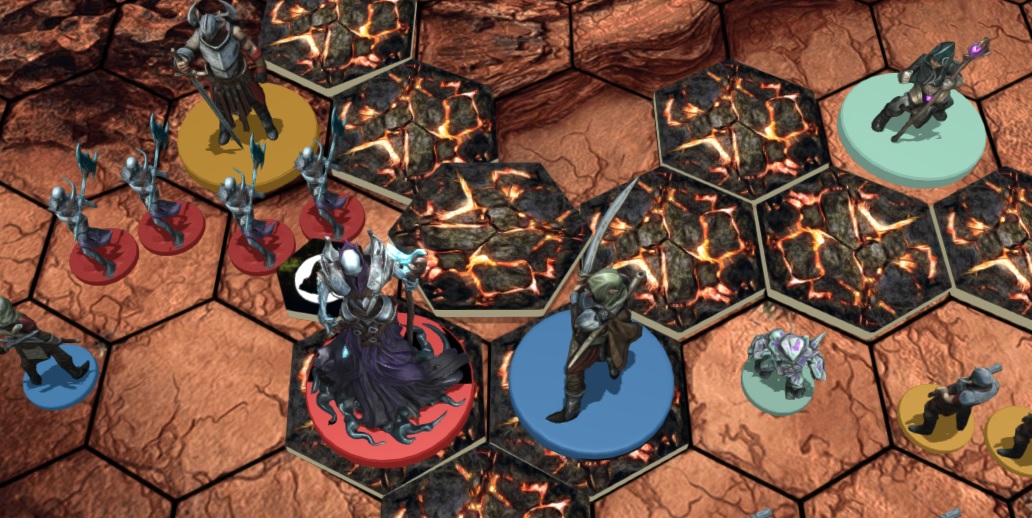
Once players have their champions selected you pick a scenario, of which there are I believe six in the back of the rulebook. Each scenario has different deployment areas, starting layouts of objective hexes and how far the turn token can go on the battle ladder (or at least I'm fairly certain that's what the faction token is for on the battle ladder). Then you deploy, roll to see who goes first, place the turn token on the battle ladder and start! I also like how each scenario has different effects that happen at the end of each turn, adds a nice touch of variety to the game and allows players to change the board around. 


The end of turn one, showing new objective hexes that were placed
Each turn of the game is broken into two phases: the plot phase and the clash phase. Models have different skills, and some have their stats changed, based on the phase of the game, which is a cool dynamic. The plot phase is generally where players will go to try and set up what they want to do in the clash phase, it's also during the plot phase that Champions can do the claim action which allows them to place down their banner which is a big way to score points. The clash phase is where models will start wailing on each other, doing damage and going for kills. 

The one thing I will say I'm not a huge fan of with the phases is how they handle model activations. In the plot phase the first player activates their entire force, and then the second player goes. Yet in the clash phase it's an alternating activation with players picking a champion or follower group to activate, and then going to the next player and so on until everything has gone. It just seems weird, and a bit jarring, to go from I Go You Go (which is a system I'm really not a fan of) to alternating is just odd to me. I'd really prefer if the whole game was done alternating, to be honest. I feel like it'd make actions in the plot phase a little more impactful. As it is it feels like skills that let you move enemy models in the plot phase aren't super great if you're the first player because your opponent can just move away and undo your plans.

Still, I will say it works alright. With the small scale of the game you don't feel like you're just sitting around not doing anything while your opponent does their entire turn (or as I call it: the 40k approach). Just a bit weird.


Finvarr and Morrigan face off next to an askew objective hex

Taking actions with models is pretty straightforward: a model (or group if they're followers) can take two actions during a turn. Generally this is an advance action (allowing a model to move up to it's movement value), or skills as printed on a model's stat card. You can also take other actions like the aforementioned Claim action, as well as the Rally or Recruit actions for a champion or followers respectively. 

I want to touch on these two actions real quick: basically if a model is knocked out (i.e. they take enough damage to meet their HP) you can use these actions to get models back into the fight, which means you can't just table your opponent and go "lol I win" because models will keep coming back. I actually really love this because it means that a few lucky rolls won't just remove a champion from the game and ruin everything. It's just a nice touch, especially after seeing so many other miniatures games that let people ignore objectives and just kill (or games that pretend to be one thing but people just kill each other the whole time anyway).

The Battle Ladder in action

One of the really cool aspects of this game is the Battle Ladder. This is a constantly shifting element that changes based on things payers do like knocking out models, making Claim actions and having a banner on an objective hex at the end of the turn. The fact that it's constantly changes as you fight is a really neat touch and makes things feel dynamic. If you have the token on your half of the ladder at the end of the turn then you win the turn and victory points. So a well laid plan can drastically shift things at the end of the turn and potentially get you the win. 

I also like that the game only goes to five points, which means that winning later turns can still win you the game even if you lose the first turn or two. It really does seem to reward planning and smart plays rather than just bashing in skulls all game (although that can work out quite well). To give an example: in our game I won the first and third turns (we only played three due to time) through planning and laying out my banners without ever taking out one of Jeremy's champions (in fact I'm fairly certain that Nia took zero damage all game) despite how many steps on the Battle Ladder that gets you.

The end of the game, banners planted and the bloodshed over
Skills that require dice rolls as super simple, which is a relief. Basically you roll a number of dice equal to a model's accuracy stat, if you roll equal to or higher than the target's dodge stat you hit. Some skills do not damage, but instead have effects like giving enemies blights that impact their stats. If the skill can do damage then you roll a number of dice equal to the skills damage value, then you subtract the target's protection stat from the roll and that determines the amount of damage done by the attack. It's all pretty slick and no bullshit, which is great.

Lastly I want to touch on boons and blights real fast. This is a cool little way to allow players to modify stats in an easy manner. It also lets you set things ups and does allow for more strategy during a game.

The only other thing I could really say that one might see as a knock against the game is that it can be a bit symbol heavy, but everything's pretty easy to remember I find. It's way less crazy on symbols than something like Wrath of Kings was (seriously, so many damned symbols), but it could potentially be a turn-off to people not as well versed in miniatures games.

Overall, how do I like it? Quite a bit, actually. It plays fast, even on Tabletopia which is nowhere near as fast as an in person experience, the rules are pretty easy to get (I've only had to ask the subreddit three quick questions to clarify things) and the fact it rewards planning and not just non-stop killing is quite a refreshing change of pace. I would absolutely recommend this to someone looking to get started in miniatures gaming as a solid starting place, and also to experienced wargamers looking for something fast paced without feeling anemic. Despite my minor gripes I can still see me playing this more in the future, and it feels like it'll be a nice addition to my collection of games while offering a very different experience from my other options.

Hope you have all enjoyed, and hopefully this was informative to people debating if they want to purchase the game.


Saturday, May 23, 2020

Unboxing: Godtear Borderlands starter box


 Alright, time to start this thing in earnest!

So what better way than an unboxing of a game that people actually care about?

I've been looking for something quick and easy to play with friends when this quarantine crap is done with, and Godtear had caught my attention a while back when Steamforged Games had initially launched the Kickstarter. I had figured it one of those "never actually hitting retail" type things because SFG had some issues (and still do, in my opinion). So I was kinda stoked when it actually came out, and I've got some buddies interested in it and figured for $40 even if I don't get deep into it at least it's not a huge investment on my part.

Now, there are two starters for Godtear: Borderlands and Eternal Glade. I went with Borderlands because I actually like both the champions in it.

Also apologies in advance for the pictures. I don't have a good place to do photography right now so I was just doing everything on my couch one night.
Front and back of the Borderlands box

What do you get?
Each of the starters comes with that same basic things: two champions, their followers and banner, ten dice, rulebook, double sided map, cards, player dashboards, and some tokens. I'm going to take a closer look at each of these, so strap in.

Rulebook
We'll start with the rulebook itself, since it's nice and easy to get out of the way. The rulebook is interesting in that, depending on which starter you buy, the examples used for actions and such are based on the models that come in that box. Pretty neat. I also like that it's in full color, as you'd be surprised how many gaming books I've run into that aren't.


Plenty of cool art, to boot!

It's only just over 20 pages total, and that includes a content page, a breakdown of the different champion types, rules and the scenarios. Nice and concise, which I appreciate for a game like this.

Maps
This is one place this game really surprised me. You get a double sided map, and I was blown away by the quality. These things are nice, thick, cardboard like most higher end board games. I was expecting something paper, more akin to what you get in the Battletech starter boxes.


What doesn't make as much sense to me is why the maps are double sided. I guess it keeps the visuals more varied, but since the terrain printed on them doesn't have any impact on gameplay it just seems like they could have saved a little money and maybe made the box a tiny bit cheaper (not that these are terribly expensive to start with, and even cheaper if you've got a local shop selling them at 20% off like I do). It's cool and all, but just seems a little superfluous.

Models
Alright, let's get into the part people actually care most about; the miniatures!


The champions in this box are Finvarr, an Elf ninja, and Titus who reminds me of a boss out of Dark Souls 2 (at least from what I've seen watching let's plays of it since I have no interest in those games). Each of these guys is around 45mm tall I believe, and they're quite well detailed. I'm pleased with the quality of the plastic used for them, too. Finvarr's sword is a little bent, but nothing horrific and I was expecting much flimsier plastic. Also not much clean-up required, which is nice. A couple of little bits of flash, nothing too bad.
FInvarr, elf bad-ass.

Titus, knightly ball-kicker.

It also comes with their followers: three Shadow Stalkers for Finvarr, and five Glory Seekers for Titus. The detail on these is solid as well, although a lot of the detail on the Glory Seekers gets drowned out by the garish yellow plastic they're cast in. I was also surprised that the Shadow Stalkers are slightly taller than the Glory Seekers, adding a nice touch of "elves are taller than men" thing.


Don't. Turn. Around.
The champions are also, obviously, taller than their followers. Not so much so as to look goofy, mind, but enough to give them a commanding presence.
Finvarr and a Shadow Stalker.
Cards
One thing I'm really glad about with this game is how few cards it has. This whole box comes with a whopping six: two for each champion, and one for each follower group.
The cards are free on SFG's website, so no I don't feel bad showing them here.
The champions have two cards each; one that outlines some special rules, and then their stat card. The followers just have a stat card. The start cards are all double sided, and you flip them depending on which phase of the turn you're in (either the plot phase or the clash phase). The other champion card is only flipped once you use their ultimate skill listed on there.
Finvarr's card is showing his clash phase, Titus' is on the plot phase side.
The cards are good quality, maybe a bit thinner than I was expecting but not to the point that I think they'll get destroyed. If you're the kind of person who worries about that then maybe some sleeves won't go amiss, but I don't think there's any major danger present here.

The rest of the components
As I mentioned, you get a few other things in the box. Some tokens, dice and player dashboards.
Token sheets

The tokens are nice, thick, card much like the map. Not a ton of them to keep track of, but I'll probably grab a small Plano to store them in at some point.

The custom dice

You also get ten of the dice required for the game. They're nothing special, minus the fact they're specific to the game. Pretty crisp print quality, which is more than I can say for some other games I own.

Play dashboard

Lastly you get three player dashboards per box. These are used for keeping track of your cards and the various tokens you'll need to mark health, boons and burdens on the various models. Your champion's skill card goes on the left, their stat card in the middle and the followers on the right. Pretty easy to keep track of, and I appreciate that you get three so when you go to play a full size game (three champions and their followers per side) you're set for dashboards.

Overall value?
Honestly, I think this is a pretty solid value. Especially if you can grab it at a discount like I did (always check your LGS first, but I know Miniature Market sells them at 20% off as well). Even if not, they retail at around $50 each, and for what you get I still think that's a pretty good deal. The models are good quality, nothing feels cheap or like they were cutting corners (something one must always be concerned with when dealing with most things funded via Kickstarter) and you get a good amount of stuff. The tray the models comes in is also specifically molded to fit those models, so that's nice until you can grab some foam for an expanding collection (I need to see if anyone sells pre-cut trays for this game).

That being said, however, I do have a couple of qualms.

Firstly, the champions and followers in these boxes are exclusive to these boxes. That sucks because I like one of the champions in the other box, but I'm not going to pay another $40 to then have some undead bitch I don't care about taking up space in my limited living space. Just sort of sucks if only one champion appeals to you in the box. I got lucky that both Titus and Finvarr appeal to me.

Secondly, all the components required to play the game only come in these boxes. That is to say that SFG doesn't sell the maps, dice, tokens or player dashboards separate. I can sort of see why, but it means that you'll always need someone in the group to have bought a starter, and that's just for two people to play. If you have a group you'll need multiple starters to cover each game, and that's provided one person per game doesn't mind not having dashboards. The dice I'm sure you could make with stickers and blank dice if you're so inclined, and maybe your own dashboards if you're artistically skilled enough to do so but you shouldn't have to to play the game.

Overall it's a good buy, and I don't regret it. The contents are good, good quality and the game looks like it should be a fun little romp without being as much crunch as some other games. I also like that SFG has put the rulebook and all the cards up as downloads on their website. It's nice to be able to check out the stuff I'm interested in before buying. Would suck to buy something I think looks awesome, only to find out it's garbage in game and I won't enjoy using it.

So I hope you've enjoyed this unboxing, and I'll get around to a review of the game once I can get around to actually playing it (all my local game shops are closed to gaming right now). Take care, y'all, and stay safe!

Tuesday, May 19, 2020

Welcome to M3!

Hello, and welcome to M3!

I thought it'd be prudent to do a post introducing myself and sort of going over the stuff you'll find on this blog.

Who am I?
I'm Spencer. I live in Utah with my wife, just south of Salt Lake City. I grew up in the suburbs in Maryland, just outside Washington D.C. I moved to Utah in 2012, and I've been here thriving ever since.


What's my gaming history/knowledge?
So here's the fun part. I've been gaming, on and off, since around 1998. I got my first real taste of "adult" tabletop gaming playing the AD&D Red Box with my brother and some friends, and then after that by playing Mutant Chronicles: Siege of the Citadel. From there, thanks to my older brother, I discovered Mutant Chronicles: Warzone right before the release of 2nd edition. I painted up some models, tried the game a little before it died and got hooked on the hobby.

In high school I played Warhammer 40k, but sold my army after I graduated and moved to a place with no wargaming scene. After moving back to Maryland to pursue my degree I got back into wargaming with AT-43, and from there I got in deeper with Rackham Entertainment and worked as a promoter for the game. I also got back into Warhammer, trying Fantasy and jumping back into 40k. I also started playing Warmachine around that time. I quickly dropped both Warhammer games after realizing that I hated the rules for 40k and didn't want to play Fantasy with the local crowd. I focused on AT-43 and Warmachine for a time, dabbled in Infinity and jumped into both Firestorm Armada and Dystopian Wars when they first came out.

In 2012 I got a job at Blue Table Painting in Utah, and I packed up my life and moved out here. I worked at BTP for about two years, dropping Warmachine and Infinity while picking up Flames of War and other games alter (including the latest edition of Warzone). After leaving BTP me and a few other former staffers started the YouTube channel Geek of Spades where we did reviews and unboxings and so forth.

In early 2019 I made the decision to step back from the gaming scene as my work and personal lives took priority, and after a little more than a year I've chosen to end my hiatus (in the middle of a global pandemic, as is my idiotic timing).

Qualifications?
Besides running and creating content for Geek of Spades, I also did solo reviews on YouTube for several years. I am also a published gaming journalist, believe it or not. I have had over a dozen reviews published in a couple of magazines, covering a variety of games from the obscure (World of Twilight, Warcanto) to slightly more well known games like Kings of War and Beyond the Gates of Antares. Between writing reviews and YouTube I've probably read and reviewed over 30 different games, so trust me when I say I have some experience.

What can you expect here?
Mostly simple stuff: showing off my mediocre paint jobs, maybe doing some unboxings, small reviews, battle reports and some editorial type stuff where I just talk about things in the industry that catch my eye.

Also expect some mild swearing, I'm a grown-ass man and this ain't for kids.

What games do I play?
So after my hiatus I made a decision to try and focus down my gaming options, and I've had to make some hard choices but I've settled on a small handful of games that all offer something different:

Gruntz
Heavy Gear Blitz
Relic Blade
Battletech
This is Not a Test (TNT)
Frostgrave

There will probably be other games in there as time goes on, I'm working on getting my local gaming group interested in some historicals (Black Powder, Pike & Shotte, By Fire and Sword).

You'll also find other games around here, mostly as I try stuff with my buddy and Geek of Spades collaborator Jeremy that he's been dying to play.

So I hope you guys enjoy, and if not then no harm done.

So stay sexy, stay safe and keep rollin' them bones.